
Chapter 1
Of Mail and Mules: The Mississippi Delta Stages a Train vs. Mule Race to Protest Slow Mail Service on the Illinois Central
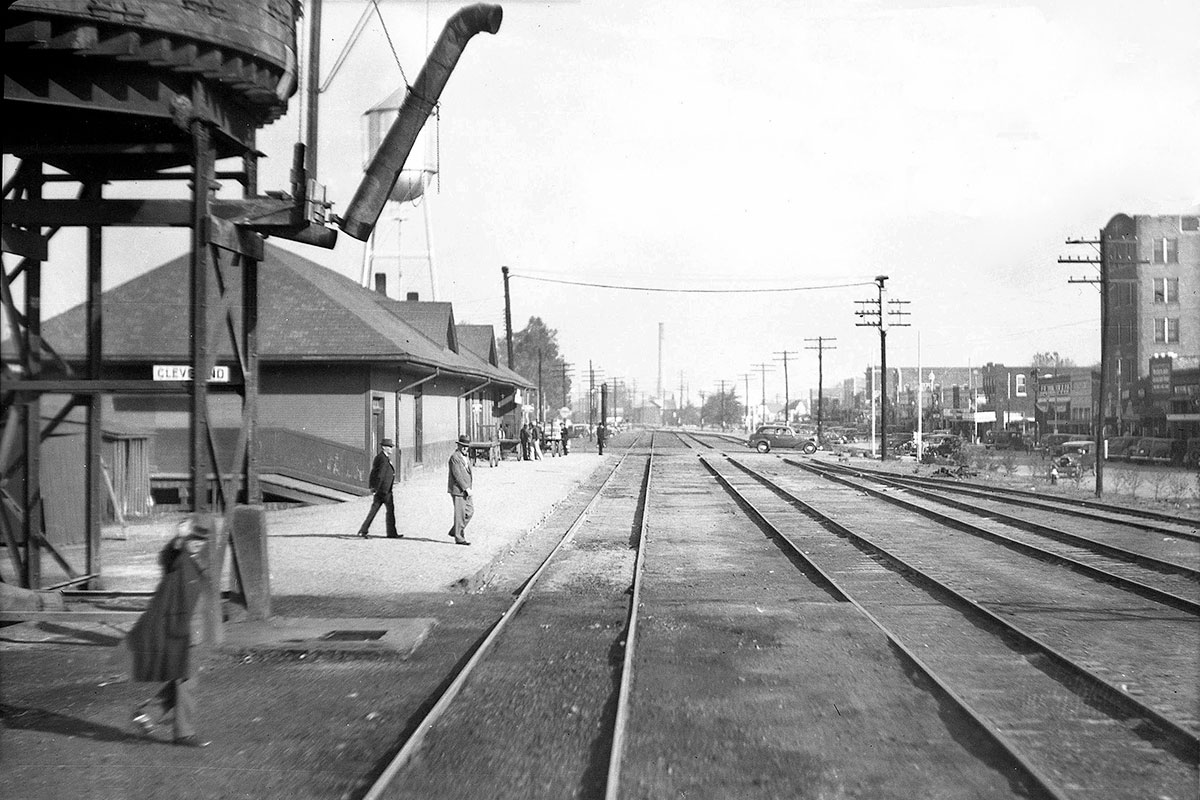
John W. Barriger III photo, David Price collection
Cleveland, Mississippi depot about 1930. During World War II as the Illinois Central lobbied to reduce passenger service on the former Y&MV main line, locals held out for better trains and concurrently for faster mail delivery. The 1948 “demonstration” about poor Mississippi Delta mail service by rail occurred here. Note the water tank at left. A standpipe for water stands by the track at the far end of the depot. The tall building at right is the Grover Hotel, where trainmen, resting from crew changes, often spent the night. The five-story hotel has been restored and remodeled with luxury condominiums. Cleveland and its hotel were named to honor President Grover Cleveland.
 By the spring of 1948, folks in the Mississippi Delta were getting envious of their neighbors on the I.C. main line. That’s where the fast trains ran. The sleek orange, yellow and brown Pullmans on The Panama Limited burnished the rails on the 394-mile New Orleans-Memphis run on a 6-hour, 35-minute schedule. The snappy new City of New Orleans delivered passengers to Memphis even faster: 6 hours 28 minutes up from the Crescent City.
Trains in the Delta were not so fast. The fact is, passenger service from New Orleans along the Yazoo & Mississippi Valley line through Baton Rouge and Vicksburg was slower in 1948 than it had been in 1925! Citizens of Greenville, Mississippi claimed they could get to New Orleans quicker by driving 40 miles west to board the Missouri Pacific at Montrose, Arkansas, or by going east to the Illinois Central main line at Winona, Mississippi. Mail service was correspondingly slow. And, to tell the truth, Deltans just wanted some attention from the world outside. Milton Winter’s mother Elizabeth Zeigel was on hand with her camera to record the scene.
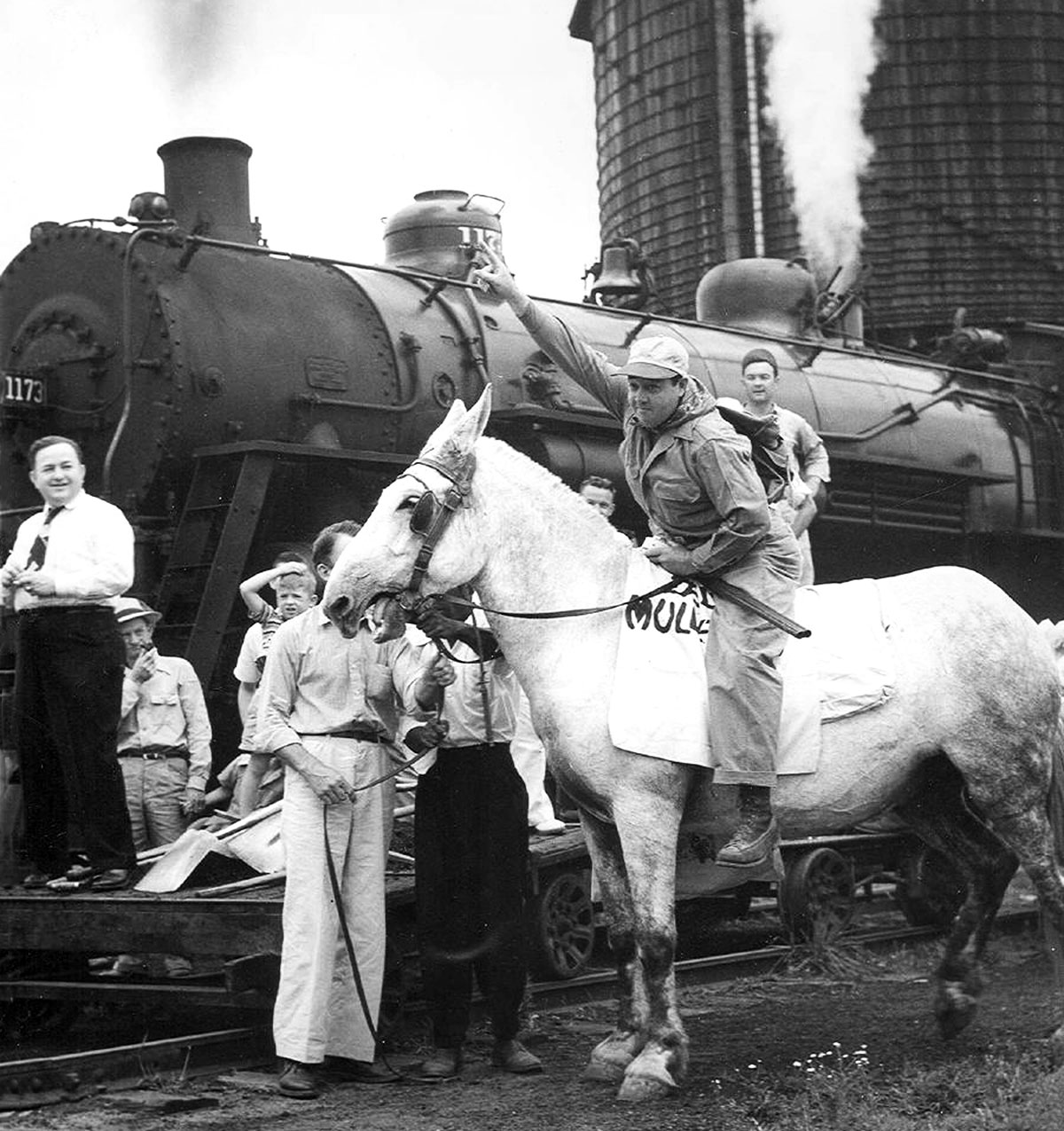
Elizabeth Zeigel Winter photo
Cleveland, Mississippi funeral director Johnny Fletcher astride a dappled gray Delta mule, specially selected for its racing ability, poses beside I.C. 4-6-2 Pacific 1173.
It wasn’t that the folks along the I.C.’s river route were ungrateful. No Sir! Why, the railroad had opened up the Delta. When the original Memphis-New Orleans route of the old Louisville, New Orleans & Texas Railroad was completed in September 1884, Anguilla, Mississippi had been the only agency station between Clarksdale and Vicksburg, a distance of 144 miles! Where now there were thriving towns and fields white with cot-ton, then there was nothing but canebrake and wilderness.
The coming of the railroad had changed all that. In 1892 the Illinois Central had purchased the financially troubled LNO&T (known locally as the “Late & Never On Time” Railroad) and merged it into its subsidiary Yazoo & Mississippi Valley System. In one stroke, the I.C. not only eliminated a serious rival, but acquired further entrance into a vast and rapidly expanding agricultural basin. Land grants enticed farmers to settle and clear land along the Y&MV tracks, and soon the I.C. had to build new docks at New Orleans to handle all the long-staple cotton that rolled down from these tributary lines in Mississippi. The railroad and the Mississippi Delta grew up together, creating fabulous wealth for lumbermen, plantation owners and the railroad that hauled their goods.
The principal passenger runs along the Y&MV were, for many years, aptly named The Planter and The Delta Express. In the 1920s, the overnight Planter made its Memphis-New Orleans trip in 15 hours, 30 minutes, with 32 stops along the way (including a bucolic detour to Greenville). Train 15 left Memphis at 4:45 p.m., arriving in New Orleans at 8:15 a.m., while Train 12, its northbound counterpart, departed New Orleans at 2:45 p.m., reaching the Bluff City at 6:15 the following morning. The Delta Express was a daylight run, which, in the early years, headed south as far as Baton Rouge. These trains, along with various other locals runs, carried passengers, as well as valuable mail and express to and from the Mississippi cotton country.
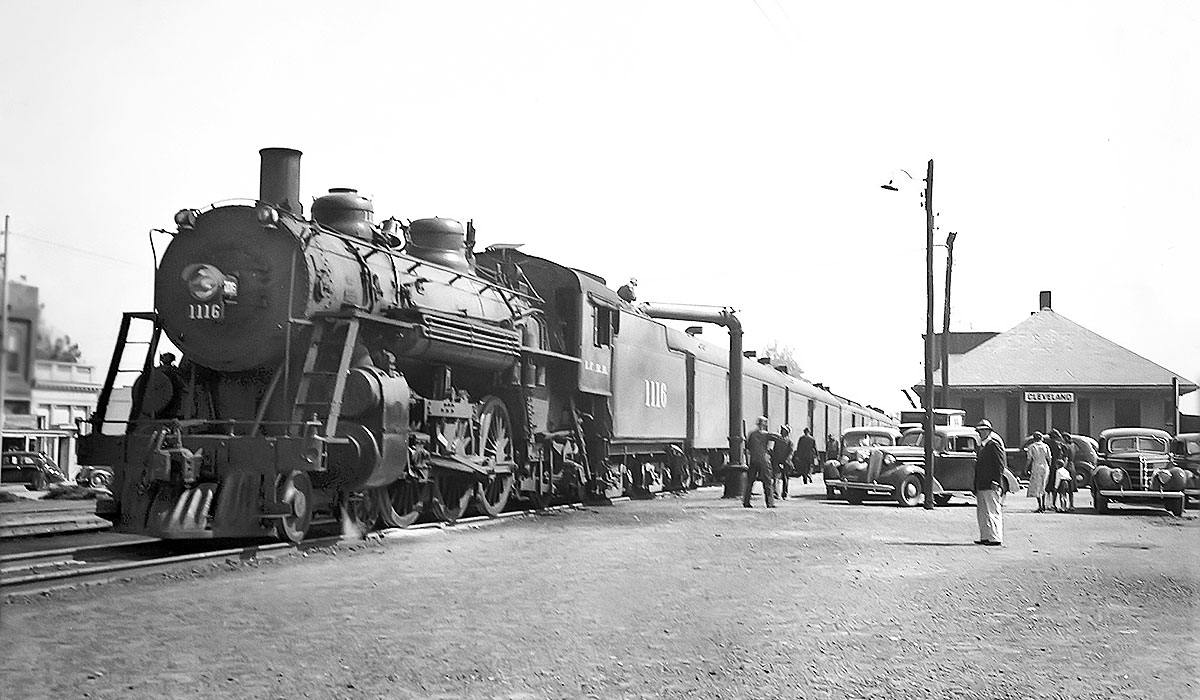
John W. Barriger III photo, David Price collection
1940’s rail executive John W. Barriger III was an amateur photographer. He took pictures along American railroads wherever his business travels took him. He caught Train 24, The Delta Express, at Cleveland as the fireman topped off the tender’s tank from the standpipe on the north side of the depot. I.C. 4-6-2 1116 is at the helm, partially blocking the crossing of S. Court Street over to Sharpe Avenue, the town’s main street (on left).
By May 1948, passenger service to the Delta on the Y&MV had been trimmed to two trains each way per day, the Memphis-New Orleans Planter and locals 23 and 24 between Memphis and Greenville (remnants of The Delta Express). Wartime padding of schedules and absorption of stops from discontinued trains had increased The Planter’s running time to a torturous 18 hours, 35 minutes. The Memphis-Greenville locals required a little under five hours to make their 151-mile journeys. Mail service suffered accordingly.
Part of the problem lay in the necessity for The Planter and Delta Express to make 22-mile back-up moves between Leland and Greenville. This consumed an hour and a half in each direction on the Memphis-New Orleans run. Community leaders appealed to the Illinois Central for faster trains, but Delta passenger service was already losing money, and the railroad had little capital for uncertain investments. Mail service continued to suffer (at least, so it seemed).
A few of the more spirited local citizens decided to stage a publicity stunt to draw attention to their desire for faster train. Why not pit a Delta mule against the iron horse? (Passenger service on this line was not dieselized until the mid-1950s.) Which would win the race?
A proper challenge was issued to the I.C. and of any other railroad that cared to compete with either Mississippi mules or the I.C. a 37-mile “Pony Express”-style mule relay between Cleveland would constitute a last, desperate attempt to establish “standard” mail service to the outside world. The mule would wait for the train if, according to alleged custom, it pulled into Cleveland late. The good-natured spoof took place on Saturday, May 22, 1948. When Train 23, the southbound Delta Express steamed into Cleveland—on time at 11:52 a.m.—the surprised passengers and crew were greeted by a wildly cheering population, divided in enthusiasm for I.C. 4-6-2, No. 1173, christened “Old Reluctant” and funeral director Johnny Fletcher’s dappled gray mule, dubbed “The Delta Mule Express.”
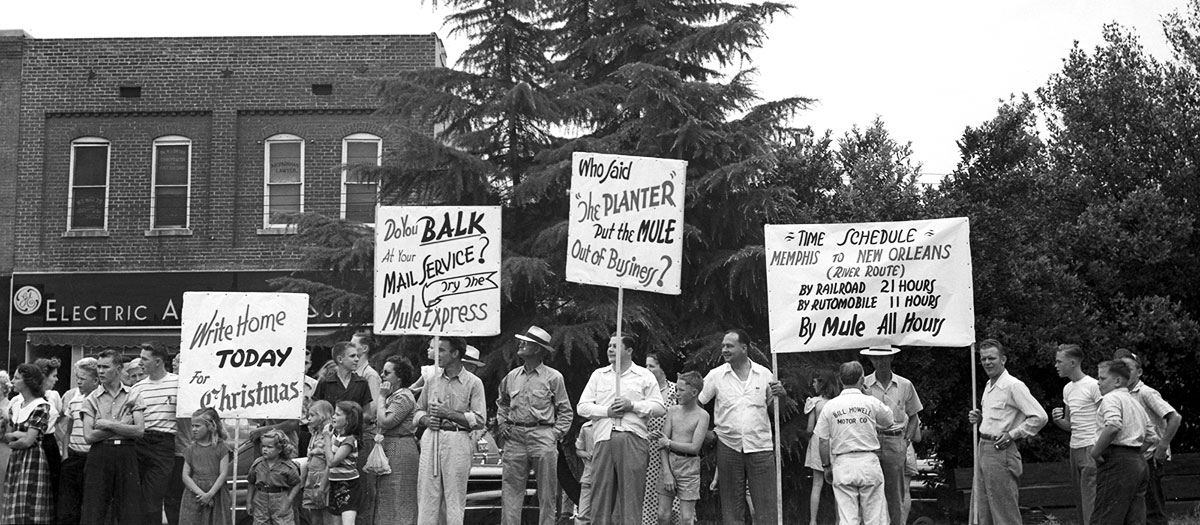
Elizabeth Zeigel Winter photo
Humorous protest signs greeted the arrival of southbound Train 23, at 11:52 a.m., on a pleasant May morning.
The race had an auspicious beginning. Placards asked, “Do you Balk at the Mail Service? Try the Mule Express” and “Who Said The Planter Put the Mule Out of Business?” Members of Volunteer Fire Department gave the signal, and with two mournful blasts of her whistle, No. 1173 pulled away with Johnny Fletcher’s mule in hot pursuit.
The race was a dead heat. Which would prevail, the Railway Post Office or the renascent Pony Express? All along the way crowds lined the station platforms to urge on the uncanny spectacle. At the end of the line, 4,000 Greenvillians waited for the finish line ceremonies. A black swing band played, “The old Gray Mule is Faster Than She Used to Be,” “I’ve Been Waitin’ on the Railroad,” and “Nobody Knows the Trouble I.C.”
Amid cheers and thunderous applause, the contest ended in victory (which everybody knew was fixed) for the “Delta Mule Express.” The last in the relay of fast galloping mules between Cleveland and Greenville (with some gaps in between) swept in just ahead of the locomotive and broke the red ribbon!
The score was Mule 1, Train 0. The I.C. did not request a rematch. Railroad officials knew that their chief competitor was not the Delta mule, but the automobile. U. S. Highway 61 paralleled the Y&MV all the way to New Orleans, and after World War II, more and more Delta folks had cars, with this traffic moving along 61’s splendid concrete path. Moreover, the Y&MV Memphis-Vicksburg-New Orleans route, with its cumbersome Greenville detour, was 84 miles longer than I.C.’s Memphis-Jackson-New Orleans main line. The Y&MV would never be able to compete for long-distance passengers.
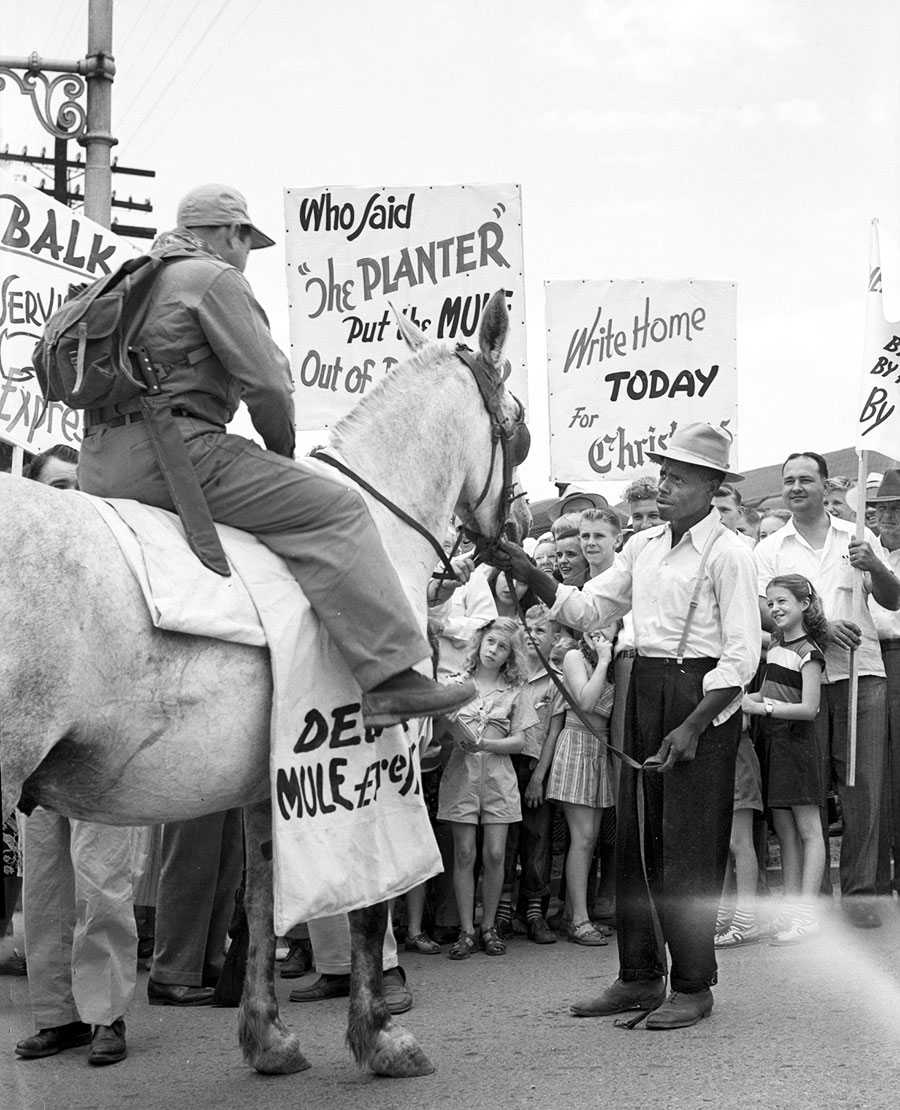
Elizabeth Zeigel Winter photo
Townsfolk turned out to see the spectacle. Some little girls seemed to be wondering what to make of the situation.
On November 27, 1949, through Memphis-New Orleans service ended on the Delta route, with the old Planter through service divided into two daytime runs—one between Memphis and Vicksburg and the other between Vicksburg and New Orleans. And on September 24, 1950, Greenville-Vicksburg service was discontinued. Trains 23 and 24, The Delta Express carried on alone on a daylight Memphis-Greenville turn.
Finally, on March 27, 1965, with cancellation of the R.P.O. contract, 81 years of rail passenger service to the Mississippi Delta came to an end. Today, neither mules nor trains carry the mail in the west Delta area of Mississippi. The tracks (except for the portion between Baton Rouge and New Orleans) have been pulled up. And mail service continues to be slow (at least, so it seems)!
This story has been told many times. This essay was reprinted in The Sandhouse: Newsletter of the Mississippi Great Southern Chapter, National Railway Historical Society (March 2013): 18-20. See also “River Route to Make Desperate Attempt to Get Mail Through—Think Mule Relay Express Faster,” Cleveland, Mississippi-Bolivar County Free-Enterprise (May 22, 1948); Hodding Carter, “Old Reluctant Runs Last; Iron Horse No Match for Mules,” Delta Democrat-Times (May 23, 1948); “For Speed Classic—‘Nature Boy’ Wins in a Balk,” Memphis Commercial Appeal (May 24, 1948); Hodding Carter, Where Main Street Meets the River (New York: Rinehart & Co., 1953): 318-25; Noel Workman, “Stopped In Its Tracks,” Delta Magazine (May-June 2012): 88-93; “No Horsing Around: Mules Outrun a Train,” Delta Democrat-Times (August 23, 2013) For a further account of The Delta Democrat-Times’ role in the escapade, see Ann Waldron, Hodding Carter: The Reconstruction of a Racist (Chapel Hill: Algonquin Books, 1993): 184-85; also Tom Bassing, “No Horsing Around, Mules Outrun a Train,” Delta Democrat-Times (August 23, 2013); Robert Milton Winter, with David S. Price, “The Great Delta Express Mule Race,” in Doomed Wilderness: How Railroads Forever Changed the Lower Mississippi Valley—The LNO&T, Y&MV, and I.C. in the Mississippi and Louisiana Deltas, plus the CO&SW (Bloomington, Ind.: 2026): 101-104.